
Are you tired of being stuck in traffic, constantly monitoring the road, and worrying about collisions? Well, the good news is that driving automation technology is advancing quickly, and we may soon be able to enjoy fully automated driving experiences. However, it's essential to understand the different levels of driving automation to know what to expect from these advancements.
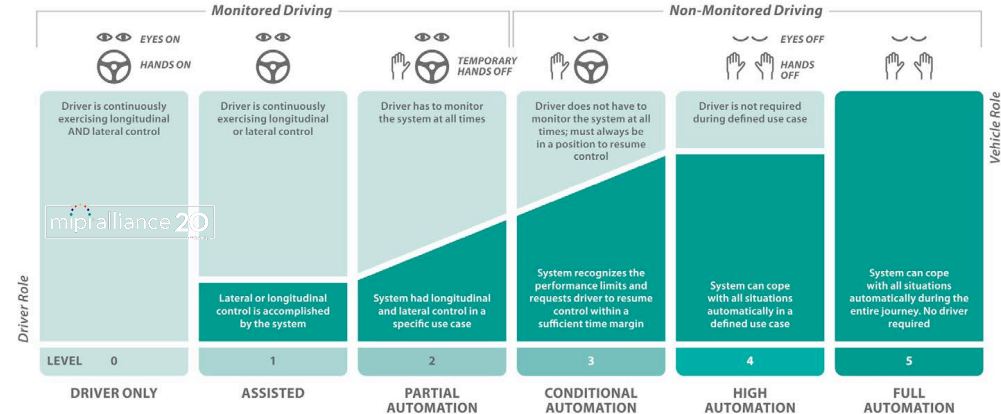
The Society of Automotive Engineers (SAE) has developed a set of standardized categories to describe the extent to which a vehicle is capable of operating itself without human intervention. These categories are often referred to as the levels of driving automation, and they range from Level 0 to Level 5.
At Level 0, the driver is responsible for all aspects of driving, including steering, accelerating, braking, and monitoring the road. There are no automated driving features in the vehicle.
Level 1 introduces some basic automated features to the vehicle, such as adaptive cruise control, lane departure warning, and automatic emergency braking. These features can assist the driver with either steering or braking/accelerating, but not both simultaneously. The driver is still responsible for monitoring the road and taking control of the vehicle as needed.
Level 2 takes things a step further, with the vehicle now equipped with systems that can assist the driver with both steering and braking/accelerating simultaneously. However, the driver is still responsible for monitoring the road and taking control of the vehicle as needed. Examples of Level 2 automation include Tesla's Autopilot and General Motors' Super Cruise.
At Level 3, the vehicle is capable of operating itself in certain situations, such as highway driving, but the driver must still be ready to take over control of the vehicle when prompted. This level of automation requires the vehicle to have advanced sensors and processing power to detect and respond to changes in the environment. Examples of Level 3 automation include Audi's Traffic Jam Pilot and Mercedes-Benz's Drive Pilot.
Level 4 brings us even closer to fully automated driving, with the vehicle capable of operating itself without the need for human intervention in most driving scenarios. The driver may still need to take control in certain situations, such as extreme weather conditions or unmapped areas. This level of automation requires the vehicle to have highly advanced sensors and processing power to detect and respond to a wide range of situations. Examples of Level 4 automation include Waymo's self-driving taxis and Cruise's autonomous vehicles.
Finally, Level 5 is the ultimate goal of driving automation technology, where the vehicle is capable of operating itself without any human intervention in all driving scenarios and environments. However, currently, no commercially available vehicles have achieved this level of automation, and there are still significant challenges to overcome.
Another crucial aspect of driving automation technology that contributes to levels 2-5 is the ability to move sensor data efficiently between different parts of the vehicle. This is where A-PHY comes in.
A-PHY is a new standard for high-speed communications within vehicles, specifically designed to support the needs of autonomous driving. It provides a robust, reliable, and secure way to transfer large amounts of sensor data between different parts of the vehicle, such as cameras, lidar, and radar systems.
By moving sensor data efficiently, A-PHY can help enable more advanced levels of automation, from Level 2, where the vehicle can assist with steering and braking/accelerating, to Level 5, where the vehicle can operate itself in all driving scenarios and environments.
For example, in a Level 4 autonomous vehicle, the vehicle must be able to process large amounts of sensor data quickly and accurately to make decisions about the vehicle's actions. With A-PHY, the vehicle can transfer data between sensors and the vehicle's central processing unit (CPU) in real-time, ensuring that the vehicle can respond to changing conditions on the road quickly and safely.
In conclusion, A-PHY is an essential component of driving automation technology that can help enable more advanced levels of automation by moving sensor data efficiently between different parts of the vehicle. As automated driving technology continues to evolve, it is likely that we will see more advancements in communication standards like A-PHY that will further improve the safety and reliability of these systems.