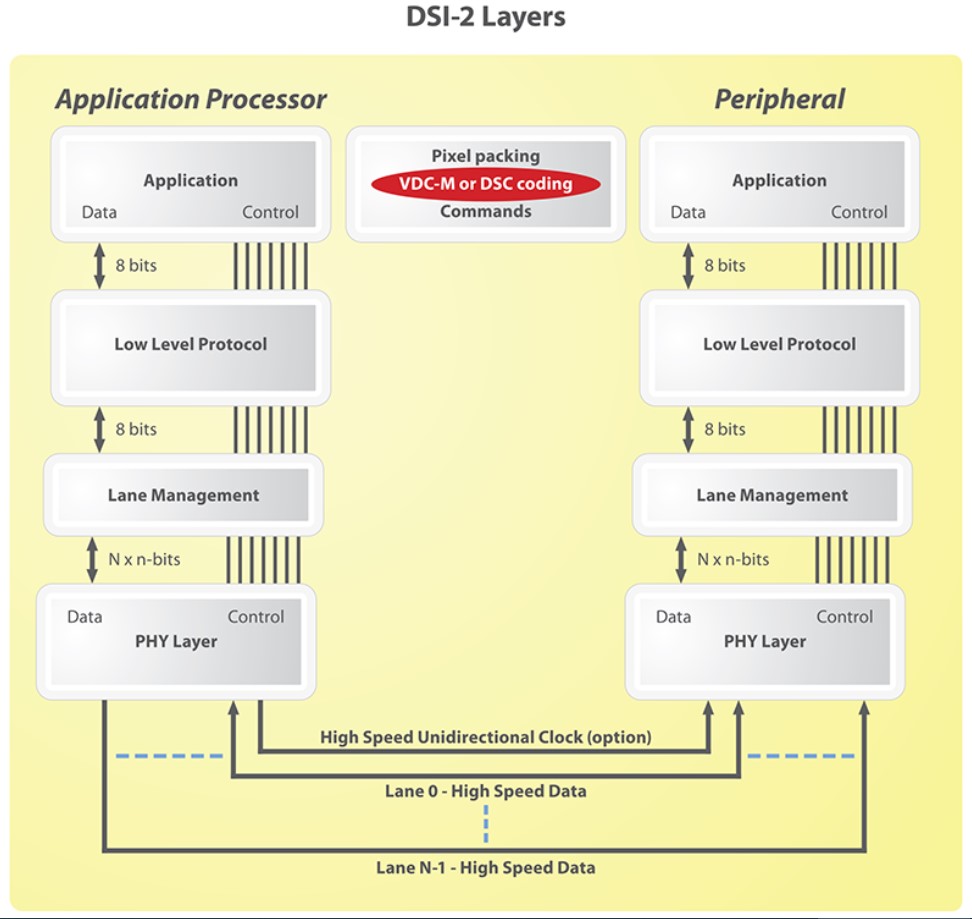
A conceptual view of DSI organizes the interface into several functional layers.
A description of the layers follows:
PHY Layer :
- The PHY Layer specifies the Transmission medium (electrical conductors), the input/output circuitry, and the clocking mechanism that captures “ones” and “zeroes” from the serial bit stream.
- This part of the Specification documents the characteristics of the Transmission medium, the electrical parameters for signalling, and the timing relationship between clock and Data Lanes
- The mechanism for signalling Start of Transmission (SoT) and End of Transmission (EoT) is specified, as well as other “out of band” information that can be conveyed between transmitting and receiving PHYs.
- Bit level and byte-level synchronization mechanisms are included as part of the PHY.
Lane Managemen Layer :
- DSI is Lane-scalable for increased performance.
- The number of data Lanes maybe 1, 2, 3, or 4 depending on the bandwidth requirements of the application.
- For the D Option (that uses the D-PHY physical layer), the transmitter side of the interface distributes bytes of the outgoing data stream to one or more Lanes (“distributor” function). On the receiving end of the D Option, the interface collects bytes from the Lanes and merges them together into a recombined data stream that restores the original stream sequence (“merger” function).
- For the C Option (that uses the C-PHY physical layer), this layer exclusively distributes or collects byte pairs (i.e. 16-bits) to or from the data Lanes.
Protocol Layer :
- At the lowest level, the DSI protocol specifies the sequence and value of bits and bytes traversing the interface.
- It specifies how bytes are organized into defined groups called Packets.
- The protocol defines required headers for each Packet, and how header information is generated and interpreted.
- The transmitting side of the interface appends header and error-checking information to data being transmitted.
- On the receiving side, the header is stripped off and interpreted by corresponding logic in the receiver.
- Error checking information may be used to test the integrity of incoming data.
- The DSI protocol also documents how Packets may be tagged for interleaving multiple command or data streams, to separate destinations using a single DSI.
Application Managemen Layer :
- This layer describes higher-level encoding and interpretation of data contained in the data stream.
- Depending on the display subsystem architecture, it may consist of pixels or coded Bit streams having a prescribed format, or of commands that are interpreted by the display controller inside a display module.
- The DSI Specification describes the mapping of pixel values, Bitstreams, commands, and command parameters to the bytes in the Packet assembly.
- For the C Option (that uses the C-PHY physical layer), this layer exclusively distributes or collects byte pairs (i.e. 16-bits) to or from the data Lanes.
